


Over the last decade, "moving to the cloud" became the default advice for businesses of every size. Cloud hosting is flexible, easy to get started with, and scales on demand. For early-stage businesses and unpredictable workloads, it remains a sensible choice.
However, an important shift is underway in 2026. A growing number of UK businesses, SaaS providers, and large e-commerce platforms are engaging in what the industry calls cloud repatriation — moving workloads away from public cloud infrastructure and back onto physical, dedicated hardware.
The reason is straightforward: the cloud is excellent for flexibility, but it carries real trade-offs at scale — unpredictable costs, virtualisation overhead, and reduced control over where your data physically resides. If you are questioning your monthly cloud invoices or hitting performance ceilings, it may be time to consider dedicated servers UK businesses are increasingly turning to for consistent, cost-predictable infrastructure.
What Is Cloud Repatriation — and Why Is It Happening?
Cloud repatriation simply means moving workloads from a public cloud provider back to private, physical infrastructure — typically bare metal dedicated servers. It does not mean abandoning the cloud entirely. Many businesses adopt a hybrid model, keeping flexible or burst workloads in the cloud while migrating stable, high-usage applications to dedicated hardware.
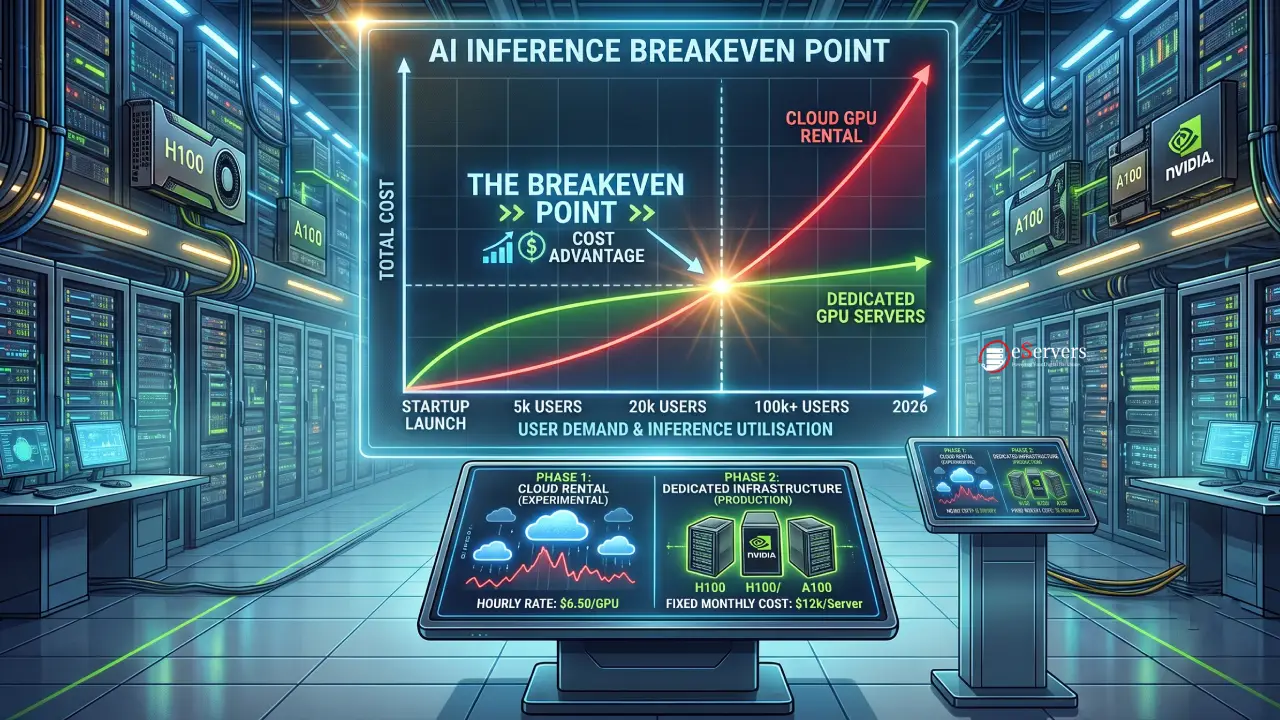
The trend is being driven by a simple realisation: the economics of cloud hosting that make sense at low scale often reverse as your application grows and your baseline resource usage becomes consistent and predictable.
Key insight: The cloud charges for flexibility. If your workload no longer needs that flexibility — because traffic is consistent and predictable — you are paying a premium for a feature you are not using.
Cloud Hosting vs Dedicated Servers UK: The Core Trade-offs
| Factor | Public Cloud Hosting | Dedicated Server UK |
|---|---|---|
| Pricing model | Pay-per-use (variable) | Fixed monthly cost |
| Cost predictability | Can fluctuate significantly | Fully predictable |
| Hardware | Shared, virtualised | 100% exclusive, physical |
| Performance | Subject to virtualisation overhead | Direct hardware access, no overhead |
| Data location | Varies — may span regions | Specific, known UK data centre |
| GDPR / compliance | More complex to audit | Clear, physical chain of custody |
| Best for | Unpredictable, variable workloads | Consistent, high-demand workloads |
3 Reasons UK Businesses Are Moving from Cloud to Dedicated Servers
1. Unpredictable and Escalating Cloud Costs
This is the most common reason businesses begin evaluating alternatives. Cloud billing covers compute, storage, data transfer, and a range of ancillary services — and costs can increase significantly as your application grows. Data egress charges, in particular, catch many businesses off guard: every time data leaves the cloud provider's network, you are charged.
A dedicated server replaces that variable billing with a single, fixed monthly fee. With unmetered bandwidth options, there are no surprises at the end of the month — making financial forecasting considerably more straightforward.
2. Virtualisation Overhead and Raw Performance
Cloud infrastructure runs on physical servers, but your workload sits on top of a hypervisor — a virtualisation layer that manages resource allocation across multiple tenants. That layer consumes processing capacity. For general web applications, this overhead is rarely noticeable. But for performance-sensitive workloads — complex databases, real-time applications, gaming platforms, or AI inference — it translates directly to latency and throughput limitations.
A dedicated server removes that layer entirely. Your application has direct, uncontested access to the physical CPU, RAM, and storage — no virtualisation, no competing tenants, no performance compromise.
3. Data Sovereignty and UK GDPR Compliance
When you host in a public cloud, the precise physical location of your data can be difficult to pin down. Large cloud providers distribute data across regions and availability zones — sometimes across borders — as part of their resilience architecture.
For UK businesses handling personal data under UK GDPR, or processing card payments under PCI DSS, being able to state exactly where data resides is not optional. With a dedicated server located in a specific UK data centre, you have complete, auditable certainty over your data's physical location.
When Does Moving to a Dedicated Server Make Sense?
Not every business should leave the cloud. The decision comes down to the nature of your workload and how your usage has evolved. Consider dedicated hosting if one or more of the following applies:
Your cloud resource usage has become consistent and predictable rather than variable.
Your monthly cloud bill is increasing faster than your revenue growth.
You are experiencing performance bottlenecks that scaling cloud instances has not resolved.
Your compliance requirements demand clear physical data isolation in the UK.
You need custom hardware — specific AMD or Intel CPU architectures, custom RAID configurations, or high-speed NVMe storage.
Your application requires DDoS-protected infrastructure with guaranteed, unshared network resources.
A useful question to ask: Is your cloud workload consistent enough that you could accurately predict next month's resource requirements? If yes, you are likely paying a flexibility premium you no longer need.
What to Look for When Choosing a UK Dedicated Server Provider
The quality of dedicated server providers varies considerably. When evaluating options for your business, prioritise the following:
Physical UK location: Your server must be housed in a UK data centre for GDPR compliance and delivering low latency to UK users.
Fast provisioning: Your dedicated server provider should be able to deploy in-stock hardware within 24 to 48 hours, not weeks.
Managed and unmanaged options: If your team handles its own server administration, unmanaged root access gives you full control. If not, a managed service means the provider handles OS updates and security.
Unmetered bandwidth: Ensure your dedicated server includes genuinely unmetered bandwidth to eliminate data egress costs.
24/7 UK-based technical support: Infrastructure issues do not respect business hours. You need engineers available around the clock.
DDoS protection: For any public-facing application, enterprise-grade DDoS protection is a baseline requirement.
How to Migrate from Cloud to a Dedicated Server: The Basic Process
A well-planned migration from cloud to dedicated infrastructure minimises downtime and risk. A typical process looks like this:
Audit your current cloud environment: Document all running instances, services, databases, storage buckets, and network configurations.
Choose your dedicated server specification: Match or exceed your current peak resource usage, and factor in headroom for growth over the next 12 to 18 months.
Provision your dedicated server: At eServers, in-stock hardware is typically deployed and ready within 24 to 48 hours.
Replicate your environment: Configure the dedicated server to mirror your cloud setup before touching live traffic.
Test in parallel: Run your application on the new server alongside the existing cloud deployment and validate performance and functionality.
Cut over during low-traffic hours: Update DNS records and monitor closely for the first 24 hours post-migration.
Decommission cloud resources: Once stable, shut down cloud instances to eliminate ongoing cloud costs.
If your team would prefer support throughout this process, eServers' UK technical team can assist with migration planning as part of a managed dedicated server arrangement.
Ready to Leave Unpredictable Cloud Bills Behind?
At eServers, we specialise exclusively in high-performance dedicated servers for UK businesses. No shared hosting, no virtualisation — just bare metal infrastructure with fixed monthly pricing, deployed within 24 to 48 hours, and backed by 24/7 UK technical support.
Frequently Asked Questions: Cloud to Dedicated Server UK
What is cloud repatriation?
Cloud repatriation is the process of moving workloads from public cloud infrastructure back onto private, physical hardware — typically dedicated bare metal servers. Businesses do this to gain more predictable costs, better performance, and greater control over where their data physically resides.
Is a dedicated server cheaper than the cloud?
It depends on your workload. For early-stage or highly variable workloads, cloud hosting is often more cost-efficient. But for businesses with consistent, high baseline resource usage, a dedicated server with fixed monthly pricing frequently works out considerably more cost-effective — especially when factoring in data egress and ancillary cloud charges.
Is a dedicated server faster than cloud hosting?
For performance-sensitive workloads, yes. Cloud servers run on a virtualisation layer that consumes some processing capacity. A dedicated server gives your application direct, uncontested access to the physical hardware — no hypervisor, no competing tenants — which translates to lower latency and higher throughput for demanding applications.
How does a dedicated server help with UK GDPR compliance?
With a dedicated server in a specific UK data centre, you know exactly where your data physically resides. This makes it straightforward to demonstrate compliance to auditors — you can point to a specific machine in a specific location. Public cloud providers distribute data across regions in ways that can be harder to audit clearly.
How long does it take to set up a dedicated server at eServers?
At eServers, in-stock dedicated servers are typically provisioned and ready within 24 to 48 hours. This means your migration window is short and predictable — no weeks-long hardware lead times.
Do I have to manage the server myself?
No. eServers offers both unmanaged and managed dedicated server options. Unmanaged gives your IT team full root access and complete control. Managed means our UK-based engineers handle OS updates, security patches, and ongoing monitoring — so your team can focus on your application rather than the infrastructure beneath it.